A Pivot Based System
4. Look at the cross over of the pivots and the trend line for entry and exits.
i not 100% understand can you please cross over of the pivots and the trend line for entry and exits example Image view
Thanks
A Pivot Based System
Hi Alex,
Thanks for your reply.
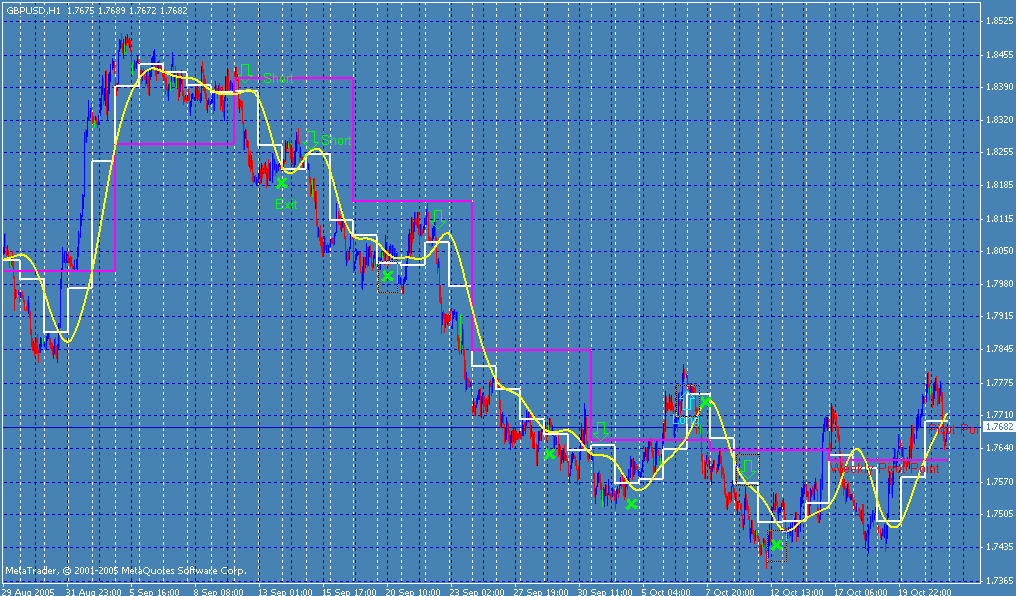
Look at the attached image of the GBP 1 hr. The same chart as before but I have added some arrows to show where you could have entered and exited.
I will try to describe a short setup:
1 - The purple line is the weekly pivot. The white line is the daily pivot.
2 - The yellow line is the RSTL which I use for a second trend indicator.
3 - The first trend indication is when the daily pivot (white line) goes below the weekly pivot (purple line) - that means the trend has changed to short.
4 - The second confirmation is when the prices (in other words the candles) are below the yellow (RSTL) line.
5 - As long as the daily pivots (white line) are below the weekly pivot (purple line) you will take only short trades. See the arrows on the chart
6- Every time when the market breaks the daily pivot and the yellow trend line in the opposite direction you exit - look at the crosses on the chart
8- Re-enter for short when the market goes below the daily pivot and yellow trend line.
I hope this makes it more clear. Please let me know if you have any questions.
I think that if you could add the 4hr and 1 hr pivots to this system you might be able to get much better entries and exits.
I would also like to see what the other members say of this idea. Perhaps other indicators could be used with this i.e. MACD, RSI, etc?
Thanks
Pivot Based System
No one interested in this?
i have interested 
but no time  (i have now much fx projects) sorry
Later...  you can try it also sometimes yourself and learn :eek:
very good lesson's by codersguru
regards#
Pivot Based System
Hi Alex and Forexts,
Thanks for that. I will try to learn but I am enormously studip when it comes to programming and know my limitations!
I do believe this does have good potential - if we can just get a 4hr pivot programmed at first. After that we can look at how to use the 3 pivots with some other indicators to get good entries and exits.
It would really be great if someone can program the 4 hour pivot so that it works like the daily and weekly one. That will give us the capability to start "visual backtesting" and experiment with extra indicators untill we can get the best combination.
Cheers
Pivot Based System
Come to think of it. It would be cool if one could specify the time for the pivot i.e. 1 hr or 4 hrs or 8 hrs etc
I did not program this indicator, however I think it may be of some use to your system
Grumpyone
Pivot System
Kal: First of all you might have something here, but on your screen shot, you have the daily & weekly livots on a 1hr chart, thats not right I think, correct me if I am wrong. The way it looks to me is that you should have the weekly & daily pivots on the daily chart.
The other thing, is that at your first green down arrow, it crosses on the vertical part of pivot line, that vertical line is only there to connect the previous periods pivot to the next periods pivot line. So if its to be a proper crossing of 2 different pivot time frames, it should happen on the horizontal level.
I dont really like your yellow line, its too noisy, but there are a number of indicators like maybe Keltner channel, CCI, Macd, EMA's, LSMA, TM, etc. The indicators would be the easy part to set up.
This might be alot better running it on the 4hr/1hr chart combo.
Interested to program
Hi Kal
Sorry for the late reply. I am pretty much interested to program your idea if you are still looking some one to program it for MT4.
Tks
Rao

- Free trading apps
- Over 8,000 signals for copying
- Economic news for exploring financial markets
You agree to website policy and terms of use